Dish of the day · Dishle #22 answer · July 3, 2026
What Is Croissant? The Pastry With an Austrian Secret
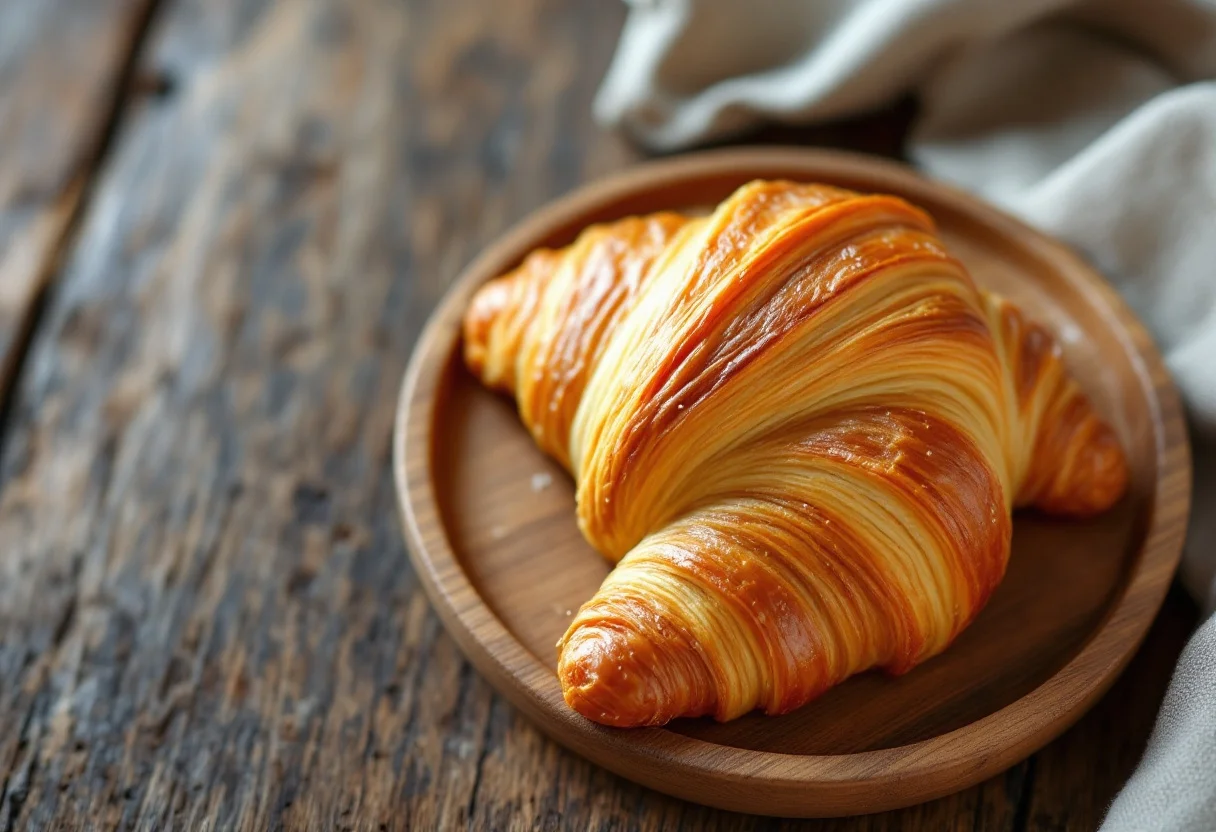
A croissant is a flaky, buttery pastry made from yeast-leavened dough that is folded and rolled with sheets of butter, then curved into a crescent and baked until deep golden. The name comes straight from the French word for “crescent,” describing that familiar curved shape. Though it is the edible symbol of a Paris morning, the croissant’s story actually begins hundreds of miles to the east, in the cafés and bakeries of Vienna.
A short history
The croissant traces back to the kipferl, a crescent-shaped bread that Austrian bakers had been making for generations. When Viennese baking became fashionable in Paris in the 1830s, French bakers adopted the shape and gave it a French name. Over the following decades they reworked the recipe, swapping the older bread-like dough for a laminated dough layered with butter, much like puff pastry. By the early twentieth century the flaky version we know today had taken hold. So while the croissant feels thoroughly French, many food historians happily call it Austrian by birth and French by upbringing, a friendly debate that has never quite been settled, and probably never will be.
What’s in it?
The dough is simple on paper: flour, water, milk, yeast, sugar, salt, and a lot of butter. The real work is in the method. Bakers fold a block of butter into the dough, then roll and fold it again and again, building dozens of thin, alternating layers. In the oven the water in the butter turns to steam and pushes those layers apart, which gives the croissant its airy, honeycomb interior and its crisp, shattering shell. Close cousins share the same dough: pain au chocolat tucks two batons of chocolate inside, while the almond croissant is split, soaked, and filled with sweet frangipane.
How do you eat it?
In France a croissant is breakfast, plain and simple. People eat it fresh in the morning, usually torn by hand rather than cut, and sometimes dunked into coffee or hot chocolate. A little jam or butter is welcome, though a good croissant truly needs nothing at all. It pairs naturally with a café au lait at a sidewalk table, where flakes scattering across the saucer are part of the charm. Outside France, bakers often split croissants for sandwiches stuffed with ham and cheese or eggs. However you eat one, the test stays the same: it should crackle and shed buttery flakes the moment you bite in.
🛎️ This was the Dishle answer on July 3, 2026.
Think you can guess today's mystery dish?
Related dishes
All dish guides · Dishle #22 hints & answer · Puzzle archive