Dish guide
What Is Apple Pie? The Dish That Isn't Really American
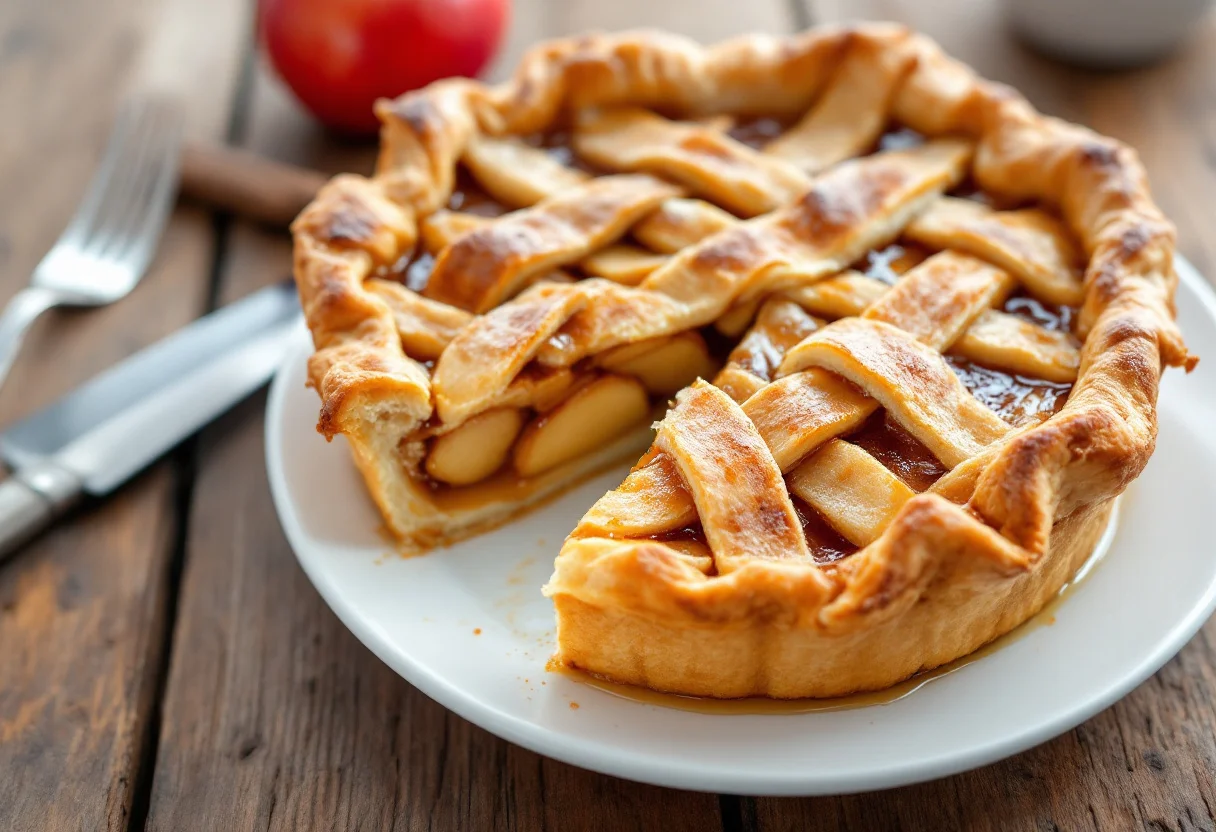
Apple pie is a baked dessert made of sliced apples, usually seasoned with sugar and warm spices, sealed inside a pastry crust and baked until the fruit is soft and the shell turns golden. The word “pie” is old, showing up in English kitchens by the late Middle Ages to describe baked dishes with a crust. Today the phrase “as American as apple pie” treats it as a national symbol of the United States, but the dish itself is far older than that country.
A short history
The earliest written apple pie recipe appears in an English cookbook from 1381, centuries before the United States existed. That early version was a sturdier thing than today’s. The crust, called a “coffin,” acted mainly as a baking container and was often not eaten. Dutch, French, and other European cooks each shaped their own crusts and fillings over the years. English and Dutch settlers carried the dish across the Atlantic, where orchards thrived and apples grew cheaply. Over time the pie became woven into American holidays and sayings. So while the United States claims it warmly, food historians happily point out that apple pie was an English and European favorite first, a friendly tug-of-war over a beloved dessert that nobody really wants to end.
What’s in it?
The filling is mostly apples, peeled and sliced, tossed with sugar and warm spices like cinnamon and nutmeg. A spoonful of flour or starch thickens the juices so the slice holds together. Bakers often favor tart, firm apples that keep their shape and balance the sugar. The crust is a simple short pastry of flour, fat, and water, rolled thin. Styles vary widely: a classic double-crust pie seals fruit between two pastry layers, a lattice top weaves strips into a window over the filling, and a Dutch apple pie swaps the top crust for a crumbly streusel of butter, flour, and sugar.
How do you eat it?
Apple pie is usually served in wedges, and it is happy either warm from the oven or at room temperature. The most popular partner is a scoop of vanilla ice cream melting on top, a combination so common it has its own name, pie “à la mode.” Others prefer a pour of cream or custard, or a slab of sharp cheddar cheese on the side, a pairing with deep roots in northern England and parts of the United States. People eat it with a fork off a plate, often as the closing course of a meal or an afternoon treat with coffee. Leftovers, many fans insist, taste even better the next day.
Could this be tomorrow's mystery dish?
Play today's Dishle and find out.